Clients struggling to share access to their
accounts? Get the access you need in minutes with a free trial of Leadsie.
14 day unlimited free trial
Extend until you onboard a client
No credit card required
Keep access to clients if you cancel


With easy one-link access requests for 13+ platforms your campaigns can go live in minutes, not days. Start free today.
Approved by Meta, Google & Tiktok
Keep access to clients' accounts if you cancel
Secure & 100% GDPR compliant



Running Instagram for one brand is manageable. Running it for five, ten, or twenty simultaneously? That's a different game entirely.
For marketing agencies, managing multiple clients' Instagram accounts isn't just about scheduling posts. It's about maintaining distinct brand voices, staying on top of comments and DMs across dozens of inboxes, hitting overlapping deadlines, keeping client approvals on track, and doing all of this without ever posting the wrong content to the wrong account.
Imagine hastily posting a fitness client's motivational quote on a legal services firm's page 😱 .
This is the nightmare scenario that shapes how smart agencies build their entire workflow.
The good news: agencies that get this right don't just survive the complexity. They thrive. The key is building systems that are repeatable, documented, and team-proof. This guide explains how teams can scale their Instagram marketing operations without the chaos.
Before a single post is scheduled, you need proper access to the client's account. And how you get that access matters.
This is rule number one. Sharing Instagram credentials creates security vulnerabilities, leaves you exposed if the client changes their password, and muddies account ownership. This will prevent disputes (or worse, accusations) further down the line and helps you maintain your agency's reputation.
🔗 If your client is still using a personal profile, you’ll need them to switch to a professional Instagram account before setting up proper access.
Send a partner request through Meta Business Manager, the client approves it, and you receive the specific permissions you need without ever touching their login credentials. Why not give access to individual accounts? Partner access keeps Meta assets firmly with the client and gives your agency a clean, professional onboarding process.
This setup also becomes important when running influencer campaigns, where you’ll need allowlisting permissions to run ads directly from a creator’s account without taking over their login.
🔗 Related article: How to Request Access to an Instagram Account
Tools like Leadsie have emerged specifically to solve this problem. They allow agencies to request access to multiple platforms at once through a single secure link, dramatically reducing the time it takes to get up and running with a new client.
Build access onboarding into your client contract process. The moment a contract is signed, trigger the access request. Don't wait until the first briefing call.
The single biggest differentiator between agencies that scale smoothly and those that constantly firefight is workflow. A documented, repeatable process is everything.
Here's what a mature agency's week typically looks like:
The key word here is rhythm. When every client moves through the same pipeline, predictability replaces chaos.
Every piece of content, no matter the size of the client account, should move through the same stages:
Tools like StoryChief allow clients to review and approve content directly within the platform, eliminating the back-and-forth email chains that eat up hours every week.
A color-coded master calendar showing all clients' content at a glance is non-negotiable. It lets you spot deadline collisions before they happen, identify content gaps, and see where the team is overloaded.
When three clients need deliverables on the same day, the best approach is a master deadline tracker and proactive client communication before there's a problem. Most clients appreciate transparency.
Agencies typically outgrow Instagram's native tools at around 3–5 client profiles. At that point, a dedicated social media management platform becomes essential because it saves you more time and effort than it costs.
🔗 Related article: Best Social Media Management Tools for Marketing Agencies
Social media scheduling tools handle content. But campaign management needs a dedicated project management layer. Asana, Monday.com, and Notion all work well here for tracking who's doing what, by when, and for which client.
🔗 Related article: Best Project Management and All-in-One Software for Agencies
For password and credential management, tools like 1Password or Bitwarden will save a lot of headache when multiple team members have to access each client's Instagram account or other marketing software. Role-based access means team members only ever see the accounts they work on.
Tools enable great work. But how you structure your team determines whether that work is consistent.
Every client account should have an account manager. That one person who deeply understands that client's brand, is the main internal point of contact, and is responsible for the quality of everything that goes out. This prevents the brand knowledge from being diffused across too many people.
🔗 Related: Learn about Online Marketing Gurus's dedicated client onboarding manager
Document everything in a shared "client playbook" for each account. This should include: brand goals, audience personas, tone-of-voice guidelines, approved hashtags, content dos and don'ts, competitor context, and historical performance benchmarks. A new team member should be able to produce on-brand content after reading it. Systems like this save internal onboarding time and ensures consistency, which leads to professionalism on your team's part.
Batching by doing similar tasks in one go is way more efficient than context-switching and trying to do 7 different things in one day across 3 client accounts. Dedicate specific time blocks to specific clients. For example, Tuesday mornings for Client A, Tuesday afternoons for Client B, rather than jumping between brand voices all day.
Replace ad-hoc check-ins with structured weekly syncs per client. Even 15 minutes per account keeps everyone aligned and prevents small issues from becoming big ones.
One of the subtler risks in multi-client management is voice bleed, where the tone and style of one client starts showing up in another's content. It happens gradually and is easy to miss until a client flags it.
Build periodic brand voice audits into your process. Scroll back through recent posts and ask: does this actually sound like this brand? If you have to think about it, the answer is probably no.
Building a content template library for each client, including caption frameworks, hashtag sets, and visual style guides, makes it much faster to create on-brand content and much harder to accidentally borrow from another client's voice.
It's tempting to repurpose content across clients using the built-in AI features in social media management platforms, especially for topical or seasonal posts. This is fine in most cases, but always have your social media manager review the content to the specific brand before publishing. Never copy-paste between accounts.
Forty percent of consumers expect brands to respond within an hour on social media. When you're managing several accounts, it can feel like you're drowning in messages and missing replies that damage clients' reputations.
The practical solution is a unified inbox that aggregates Instagram DMs and comments from all client accounts in one place. Tools like Sprout Social offer this with AI-powered reply suggestions that help teams respond quickly while maintaining each brand's distinct voice.
Build per-client response template libraries for common inquiries like FAQs, complaints, booking requests, and so on. Templates speed up response times without sacrificing quality.
Assign community management shifts if you're running a large number of accounts. A dedicated 30-minute slot every few hours prevents inboxes from piling up.
Data is what separates agencies that retain clients from those that lose them after the first contract period. Anyone can pull numbers from dashboards, but great reporting that tells a story is what clients look for.
Before a campaign begins, agree on what success looks like for this specific client. Follower growth matters more to some clients; conversions matter more to others. Misalignment here leads to disappointed clients even when the work is strong. Take into account the industry benchmarks, nuances, and opportunities.
Use the same reporting template across all clients. This makes report generation faster and builds a professional, consistent client experience.
🔗 Related article: Best marketing agency reporting software (for SEO and PPC)
Meta Business Suite, Sprout Social, and similar tools offer automated report generation. Set these up so reports are delivered on a schedule, not when someone remembers to run them.
The best client reports don't just show numbers. They explain what happened, why, and what the plan is for next month. A paragraph of context is worth more than a table of metrics.
When one agency team member has access to a dozen client accounts, a single security incident can have enormous consequences.
Team members should only have access to the accounts they actively manage. When someone leaves the team or changes accounts, revoke access immediately.
Enable 2FA on every client account managed through your agency. If you have not already done so, see how to enable 2FA for your Meta Business Portfolios here. No exceptions.
Keep a log of who posted what and when across all client accounts. This is critical for accountability if something goes wrong, and it protects both the agency and the client.
Build a formal off-boarding checklist for when client relationships end. This should include revoking all team member access, transferring any remaining assets, and documenting the account handover.
💡 Included in all Leadsie plans: One-Click Offboarding for Google 👋
You can now remove client access across:
• Google Ads
• Google Business Profile
• Other connected Google integrations
All in one click.
Try Leadsie free for 14-days, no credit card needed to start!
The agency relationships that last are built on transparency, proactive communication, and the sense that the client is genuinely informed without being in the weeds.
At the start of every engagement, agree on: how many revision rounds are included, what the approval timeline looks like, who the single point of contact is on each side, and what response time the client can expect.
Share read-only access to the content calendar so clients can see what's planned. This reduces the number of check-in calls and makes clients feel informed. But keep them out of the scheduling tool itself. Nothing slows a workflow down like clients directly editing scheduled posts... too many chefs in the kitchen!
Don't wait for clients to ask how things are going. Send a monthly performance summary that covers what was published, how it performed, and what the plan is for the next month. This builds confidence and significantly reduces churn.
The agencies that manage multiple Instagram accounts well aren't necessarily the ones with the best designers or the most creative copywriters, although those things matter. They're the ones with the best processes.
The most common failure mode isn't using the wrong software. It's not having a documented, repeatable workflow that every team member follows the same way every time.
When you have strong systems in place —for access management, content creation, client approvals, community management, reporting, and security — you can take on more clients, produce better work, and keep the relationships you've built.
The goal isn't to manage chaos more efficiently. It's to eliminate the chaos in the first place.
Build the process. Document it. Train your team on it. Then iterate as you grow.
🔗 Relevant article: 7-Step Client Onboarding Process: A Definitive Guide for Marketing Agencies
Every day spent waiting for account access is a day you're not launching campaigns, delivering results, or generating revenue.
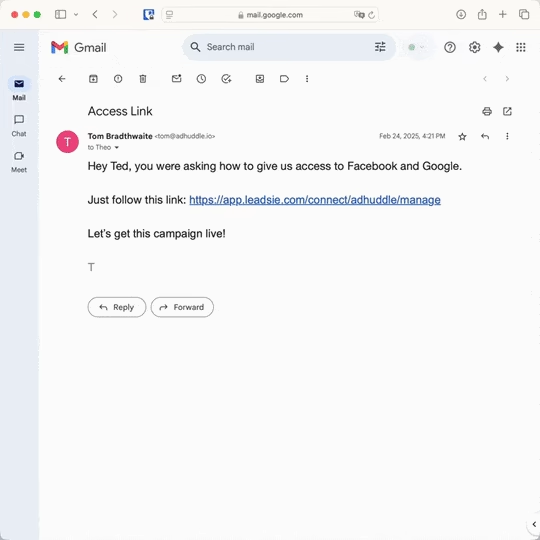
Leadsie is a client onboarding software that helps agencies request and receive access to client marketing, advertising, and social media accounts with one secure link. Instead of managing endless emails, permission requests, and troubleshooting sessions, you send a link to your client, they approve the permissions you've requested, and you get access in minutes, not days.
Clients can grant access to Meta, Google, LinkedIn, TikTok, Shopify, and 14+ other marketing platforms without sharing passwords.
✅ Request, manage, and remove client access from one place
✅ Replace hours of emails, admin work, and onboarding calls
✅ Scale client onboarding without adding operational overhead
✅ Reduce your agency's turnaround time by over 50%
✅ Start billable work and billing cycles sooner
✅ Create a professional onboarding experience that helps retain clients
✅ Keep access secure with 100% GDPR and CCPA-compliant workflows
💬 "I never want to do onboarding without Leadsie!" - Alyssa, Meta Ads Manager
🎁 Start your free 14-day trial today —no credit card required.
P.S. It's risk-free, and you get to keep your account connections after the trial ends. 🙌

Ekta Swarnkar is a freelance B2B writer for SaaS and marketing brands. She's helped various companies to grow their visibility, authority, and revenue with long-form, actionable content.


Clients struggling to share access to their
accounts? Get the access you need in minutes with a free trial of Leadsie.
Approved by Meta, Google & Tiktok
Keep access to accounts if you cancel
Secure & 100% GDPR compliant
Delete your onboarding PDF. Cancel the video call. Just send one link, and get hassle-free access to 13+ platforms in minutes. Start free today.
Approved by Meta, Google & Tiktok
Keep access to clients' accounts if you cancel
Secure & 100% GDPR compliant
Never by sharing passwords. The correct method is to request access through Meta Business Suite. You send a partner request, the client approves it, and you receive specific permissions without ever needing their login credentials. This keeps account ownership with the client and protects both parties if the relationship ends.
Tools like Leadsie simplify this further and enable agencies to request access to multiple platforms quickly at once through a single secure link, cutting onboarding time significantly.
This depends heavily on the complexity of each account. Consider the posting frequency, community management volume, and campaign activity as they all play a role. As a rough benchmark, an experienced social media manager with good tooling can typically manage 6–10 accounts at a moderate posting cadence (4–5 posts per week per client).
The number drops significantly if accounts require heavy community management, paid campaign oversight, or frequent content production from scratch. Accounts with strong content template libraries and efficient approval cycles allow for a higher ceiling.
Yes, but with care. Repurposing a content idea or format across clients is efficient and perfectly fine, such astaking a seasonal content concept and adapting it for three different brands. What agencies must never do is copy-paste content verbatim from one client's account to another.
Every piece of repurposed content should be fully rewritten in the client's specific voice, adapted to their audience, and checked for any details that could only apply to the original client.
If access was set up correctly through Meta Business Suite or Leadsie, ending access is clean: remove your agency from the client's Business Portfolio, and all team permissions are revoked simultaneously.
Build a formal off-boarding checklist into your client contract will protects both parties and ensures a professional handover. This should include steps and/or a checklist for: revoking all team member access, transferring any content assets or analytics data the client is entitled to, and documenting the account status at handover.
No, you can't create two Instagram accounts with just one email. Instagram requires each account to have its own email or phone number so you can log in if you forget your password.
You can add up to 5 individual accounts on the Instagram app. It's super handy because you can switch between your personal and business accounts (or your clients’ accounts) without logging out and back in.
Having a separate Instagram account for business is smart. It keeps things professional and lets you focus on posting the right content for your customers. Plus, you get excellent tools to monitor your posts, making your business look even better.
To switch between your Instagram accounts, tap your Instagram username on the top left. This will bring up a menu where you can select the account you want to switch to. You can also tap and hold the profile picture to quickly toggle between active accounts.
Questions unanswered? Check out our help center or get in touch 🤠
© Leadsie Ltd 2024